
20 Interviews later...
- June Steensen
- 17. jan. 2025
- 5 min lesing


When I started this project, I wasn’t looking for a headline or a quick hot take on AI. I wanted to understand, properly, how artificial intelligence is changing the way companies actually use consultants.
There was one problem: I was nineteen, with no internship, no client projects, and no access to the inside of a consulting firm. But if I couldn’t look at consulting from the inside, maybe I could flip the perspective. Instead of asking consultants what they think is happening, why not ask the people who buy their services and who more interesting to talk to than their biggest clients.
So that’s what I did. I reached out to the CEOs of some of Norway’s largest companies and asked for their time. I expected maybe one or two to say yes. To my surprise, twenty of them agreed to meet.
Over the course of these conversations, I found myself in boardrooms, office kitchens, and Teams calls, asking the same question: what role does AI play in how you think about consultants today, and in the future?
The answers were not vague predictions about “someday.” They were practical, immediate, and often brutally honest. Some CEOs laughed at how quickly AI has replaced the tasks they used to pay consultants for. Others admitted they still rely on consulting firms, but only for specific value that AI or their internal teams can’t yet provide. A few openly questioned whether the billable-hours model can even survive.
Twenty interviews later, the picture is clearer than I ever imagined. AI isn’t replacing consulting projects, at least not yet. But it is dismantling the foundations that consulting has stood on for decades.
Look, I’ve gotta acknowledge the elephant in the room: most of the CEOs told me it might be way too soon to ask these questions. And they weren’t wrong, I’ll own that. They don’t have crystal-clear answers yet or enough data to respond with certainty.
But here’s the thing: maybe the questions came fast, but that’s kind of the point. If you only start asking once everything is obvious, you’re already too late.
AI and the Future of Consulting – CEO Perspectives
1. Automation of Junior-Level Work
“As much as 60–70% of the basic, repetitive groundwork… will disappear by being automated.”
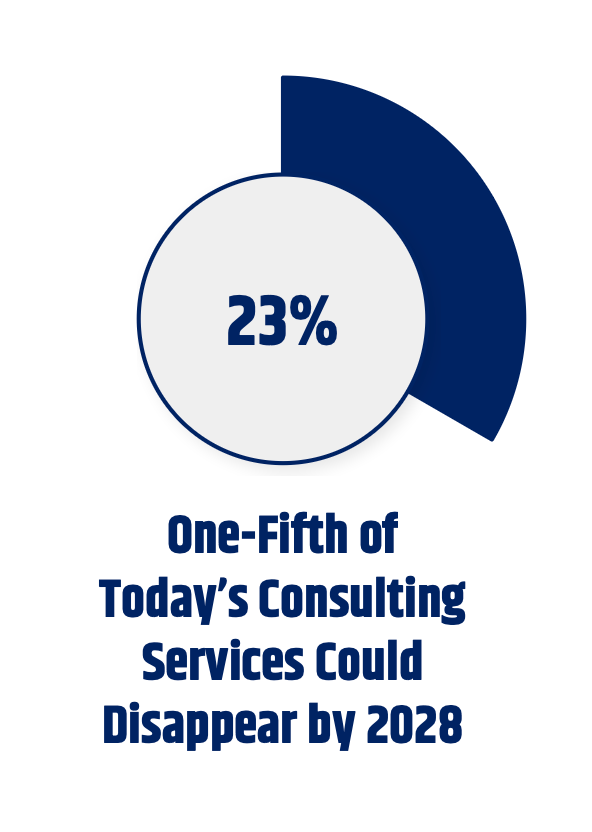
Several CEOs noted that the junior-level tasks that historically fueled consulting firms’ leverage model are rapidly disappearing. Work like gathering data, synthesizing reports, or preparing slide decks is now being automated by AI tools.
Impact: This undermines the traditional pyramid structure of consulting, where large teams of juniors handled groundwork while seniors focused on analysis and client management.
Shift: Instead of weeks of manual work, CEOs now expect outputs in hours which might put more value on speed, interpretation, and implementation the real differentiators.
“In the last three months, it has almost exploded. Tasks that used to take a team of juniors to research, summarize, and prepare, we now run through AI tools in minutes. That changes the whole role of consultants.”
The repeated phrase “the whole role of consultants is changing” reflects a systemic shift: clients no longer see consultants as providers of information, but as partners in framing problems, validating insights, and delivering solutions faster.
2. From Scarcity to Abundance of Knowledge
“Before, consultants could sell a lot of insight because they sat on a universe of knowledge that was hard for us to access. Now we get that very easily with AI.”
Historically, consulting sold access: firms had proprietary benchmarks, databases, and networks. That knowledge asymmetry justified premium fees. AI, however, flips scarcity into abundance.
Knowledge, once rare, is now commoditized.
The new scarcity lies in judgment, creativity, and contextualization, knowing how to apply abundant information to a specific business challenge. So the judgment that consultants have will still be relevant
“Therefore you may not need to hire industry specialists with a network in England, Germany, and the Netherlands to capture that kind of information.”
In other words, geographic and sector-specific expertise — a traditional selling point of large firms — is less critical when data can be extracted and compared instantly through AI tools.
3. Building AI Competence In-House
“We buy competence just for inspiration and to get started. The point is to do the rest internally so it becomes part of our employees’ tools.”
Many CEOs described a deliberate strategy: import only enough consulting expertise to bootstrap learning, then internalize AI capability.
Consulting is shifting from outsourced capacity to temporary scaffolding, clients want help standing up tools and processes, but then expect to own and operate them.
This is especially threatening to large consulting firms:
“That is probably the big risk for large consulting firms compared to many of the smaller ones, that now smaller firms can do things that only the big ones could do before.”
AI lowers entry barriers: smaller firms and internal teams can replicate capabilities that once required scale. The traditional advantage of large firms armies of analysts and proprietary knowledge erodes.
4. Skepticism About Consulting Costs
“Why pay so much when we can do it ourselves?”

A recurring theme was client skepticism about consulting pricing models. AI creates transparency — clients know what can be done quickly and cheaply.
Perceived Value Gap: If consultants deliver AI-generated insights but charge legacy prices (based on manual work), clients feel overcharged.
Trust Challenge: Some CEOs worried about paying for “AI reports dressed up as human effort.”
“They want to sell more hours even if they use AI. So now we’ll have to start specifying AI use in our retainers, so they are forced to use AI to a greater extent.”
Clients anticipate restructuring contracts, pushing for:
AI use to be explicit and priced fairly
Consulting hours to shift from production to higher-value advisory and implementation work
This signals a pricing model crisis: firms can’t just pocket AI-driven efficiency gains — clients expect them to be passed along.
5. Redefining What Consultants Should Do
“There will be less PowerPoint and more technological competence.”
Despite skepticism, CEOs are not rejecting consultants altogether. Instead, they want a different kind of partner:
Less “telling” and more “doing”
Not just abstract strategy, but hands-on implementation of AI and tech solutions
Ability to translate emerging technologies into concrete use cases
“That’s why we challenge consultants directly: don’t just tell us what AI could do, show us concrete, practical use cases that deliver results.”
Consultants are still valuable as thought partners and change agents, but credibility now comes from technical depth and implementation capability, not just polished slides.
This points to a new consulting model: hybrid advisors who can strategize, code, and integrate solutions.
Fun fact:

Overall Analysis
Across the 20 interviews, five themes stand out:
Automation is hollowing out junior consulting work → pyramid model under threat.
Knowledge scarcity has flipped to abundance → new value lies in judgment, not information.
Clients are insourcing AI competence → consultants risk being sidelined unless they help clients build self-sufficiency.
Pricing models are under pressure → AI transparency forces firms to rethink how they charge.
Consultants must become tech-competent implementers → future work is less about slides, more about code and solutions.
The human element cant be replaced →


Kommentarer